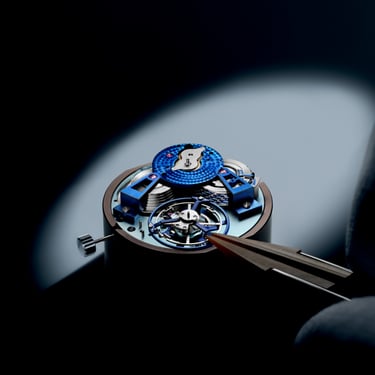
Breguet Celebrates Its Tourbillon Legacy with a Series of Exclusive Creations
In 2026, Breguet pays tribute to the invention of the tourbillon, for which Abraham-Louis Breguet was granted his historic patent on 7 Messidor Year 9 according to the French revolutionary calendar, corresponding to 26 June 1801.
Fashion Press Corner / Breguet / Photos: ©Breguet
6/26/2026
This eminent complication has been an enduring part of day-to-day life for the Manufacture Breguet, its collectors and the entire watch industry – which has since widely adopted its founding principle – for exactly 225 years.
Since then, the Manufacture has continued to foster the progress of the great watchmaker’s invention, constantly drawing on its original inspiration, while over the decades introducing valuable technical refinements serving a single purpose: the quest for precision. All the new models presented today are part of this vision.
An invention at the heart of history
1793: the turmoil of the French Revolution eventually convinced Breguet to leave his workshop on the Quai de l’Horloge and enjoy a much-needed escape with his family. In Neuchâtel and subsequently in Le Locle, the watchmaker took advantage of this respite to revisit some of his creative visions and contemplate the future of his company.
Upon his return to Paris in 1795, Breguet unveiled a number of inventions that would prove decisive not only for his own future, but also for that of horology as a whole: the sympathique clock (a clock that sets the time of a pocket watch that is placed on top of it), the souscription watch (whose minimalist design redefined the aesthetic codes of watchmaking, and which the House of Breguet reinterpreted in 2025), along with the à tact watch (serving to read the time by touch), among many others.
A.-L. Breguet developed two new mechanisms: firstly, the constant-force escapement, patented in 1798 and secondly, a Tourbillon regulator device patented three years later in 1801. It is the latter that we are now celebrating on its 225th anniversary.
Origins of a watchmaking revolution
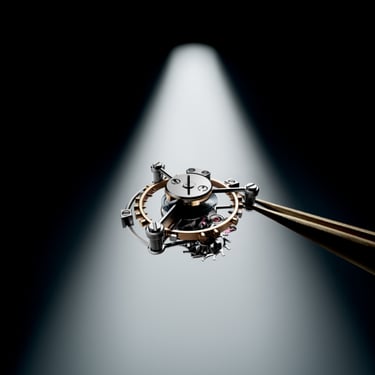
The Tourbillon regulator, or Tourbillon, is based on the observation that the oscillation of certain watch components – and more critically the balance and balance-spring – is “pulled” downwards by the force of gravity. The regulation organ’s operation is thus affected, and indeed unevenly so, when the watch is held vertically – which was almost always the case for a pocket watch in Breguet’s day.
To resolve this difficulty, Breguet was naturally aware that he could not defy the laws of gravity. In a sense, he therefore circumvented the problem by inventing a system based around a cage (also known as a cage) in which the escapement and the regulating mechanisms (balance and balance-spring) are enclosed and kept in constant rotation around an axis, in all positions. The balance-and-spring assembly’s centre of gravity is thus continually realigned with the axis of rotation, compensating for the adverse effects of the uneven oscillation of a watch held in a static position. Breguet designed this system to “mix up” all vertical positions and ultimately achieve higher average accuracy.
If we consider that the Tourbillon took shape in Breguet’s mind between 1793 and 1795 (during his stay in Switzerland), six years elapsed between his return to Paris and the granting of the patent on 26 June 1801 – and a further six years would pass between the official approval of this patent and the first sales.
Breguet and his employees went on to produce 40 Tourbillons between 1796 and 1829, along with nine other such timepieces that were never completed and are recorded in the accounts as written off, scrapped or lost.
Since then, the Manufacture has never ceased striving to perfect this mechanism – one of the trickiest and most complex in the realm of Haute Horlogerie – in order to open up new chronometric horizons. With this in mind, the House continues to develop new watchmaking processes (high frequency) and also ventures to explore other disciplines with a view to enriching the Tourbillon with the latest scientific breakthroughs (such as the constantforce magnetic escapement).
Classique Tourbillon 7357
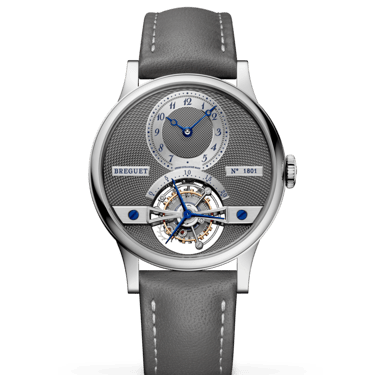
The Classique Tourbillon 7357 follows in the footsteps of a historic Breguet model : Ref . 3350 , which was none other than the first Tourbillon wristwatch produced by the modern -day Breguet in 1989 .
Now one of the timepieces most sought - after by collectors, this model was powered by the Calibre 558 , a movement of equal historical significance.
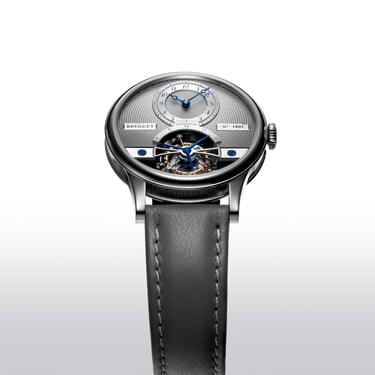
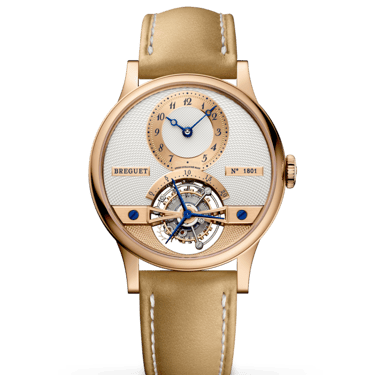
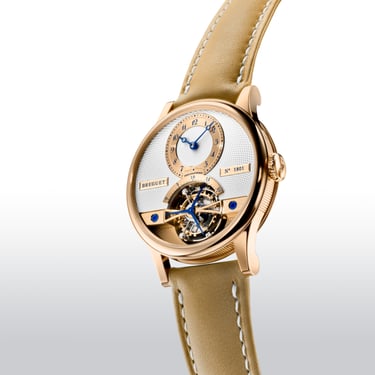
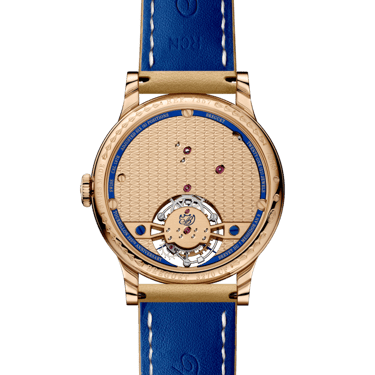
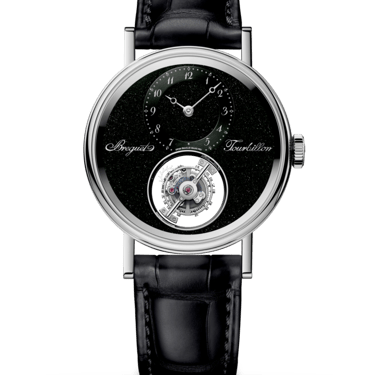
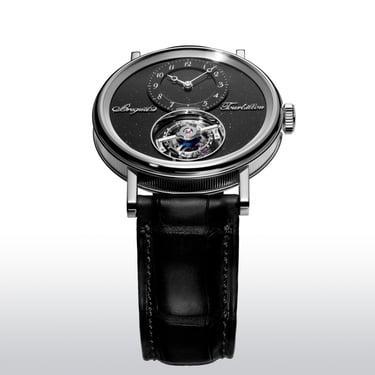
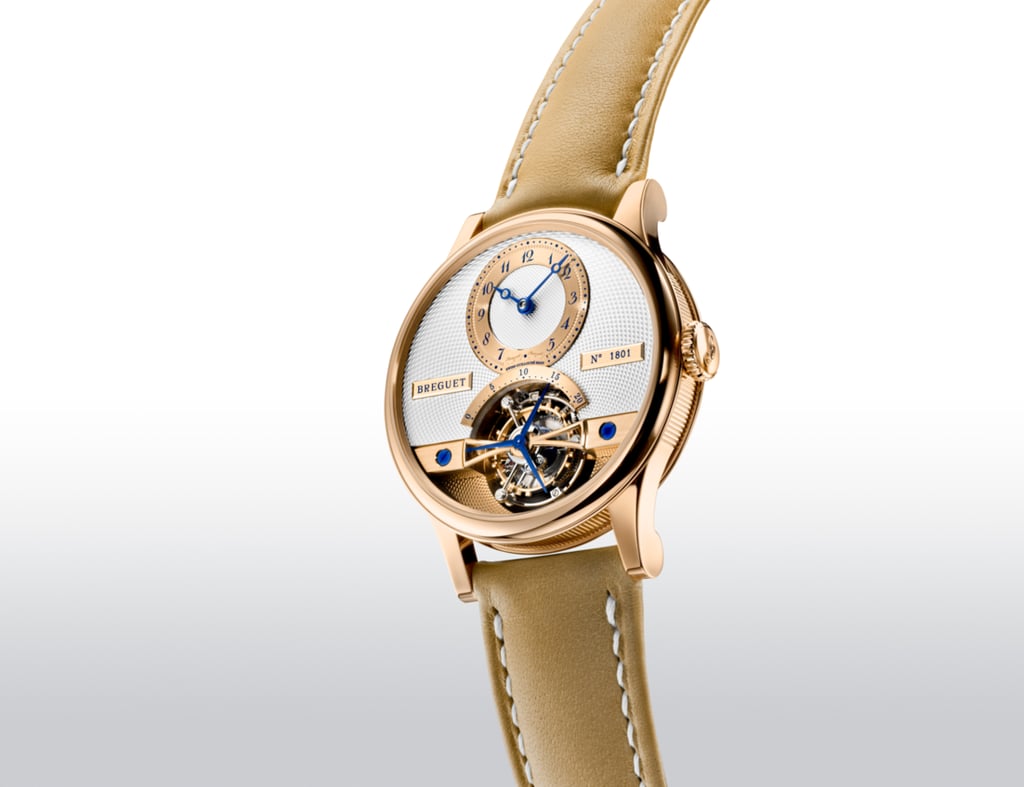
The new Classique Tourbillon 7357 is its direct descendant, based on an optimised version of the famous 558 movement now known as Cal . 187 B . To mark the Tourbillon patent’s 225th anniversary, the watch is available in two versions (platinum and Breguet gold), bearing the Breguet hallmark.
A prestigious lineage
Drawing inspiration from heritage to shape the future of watchmaking is a philosophy that defines Manufacture Breguet today, just as it did A.-L. Breguet in his own time. The great watchmaker never regarded his Tourbillon as a singular, definitive creation. He explored its every possibility, constantly refining his invention. This was a never-ending process of continuous development that his own son continued to pursue after his father’s death in 1823.
The House that bears their name follows the same path. When it unveiled Ref. 3350 in 1989, the Tourbillon – and, beyond that, traditional Haute Horlogerie as a whole – was of interest to only a handful of collectors around the world who were committed to preserving mechanical craftsmanship.
Nearly 40 years later, the legacy mission championed by the House of Breguet has led to a magnificent resurgence of the Tourbillon, which has returned to the forefront of watchmaking desirability. While the invention that we owe to Breguet has been widely adopted by virtually all players in the industry, only the Manufacture possesses its historical legitimacy, backed by the famous patent of 26 June 1801, exactly 225 years ago. The new Classique Tourbillon 7357 embodies this precious heritage.
A Tourbillon rooted in modernity
Whereas Ref. 3350 was a 20th century Tourbillon, the two new Classique Tourbillon 7357 models are resolutely 21st century creations.
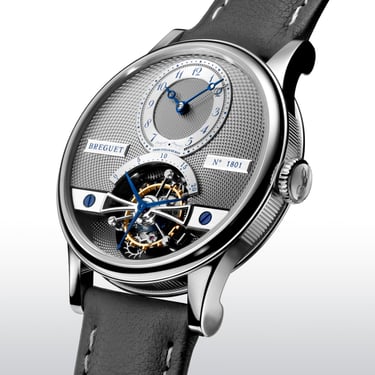
Their aesthetic codes draw on the master design of Breguet’s 250th anniversary collections in 2025. The lugs have been entirely redesigned to better follow the curve of the wrist. The Arabic numerals which A.-L. Breguet had already introduced in the late 18th century with a remarkably modern touch – once again take centre-stage on the 18K gold dial. This features the brand’s two most iconic guilloché patterns: Clous de Paris in the centre and Barleycorn around the periphery.
The Tourbillon at 6 o’clock is positioned a few tenths of a millimetre below the level of the dial, directly on the mainplate, so as to showcase it more effectively and lend depth to the composition. The three arms of its seconds hand are delicately curved to follow this contour. The single crossthrough bridge on Cal. 558 has been redesigned as a double rounded-off polished “arched” bridge. Finally, the hours and minutes are displayed by traditional Breguet hands and the caseband bears the signature hand-guilloché fluted pattern.
Finally, both new versions feature four peripheral inlays finished in a Bleu de France treatment, a colour reserved for exceptional timepieces. The two lower appliqués pay tribute to A.-L. Breguet, his invention and its contemporary legacy with the French inscriptions: “Brevet du 7 Messidor An 9” and “Tourbillon 225e Anniversaire”.